Most websites cost money. Yours should make it.
That’s the whole brief, and it’s why the company is called what it’s called. Whether your site takes orders or takes enquiries, it gets built to do that one job — and it’s built by the person who runs the ads pointing at it.
Start with a quick call.
Most people aren’t sure what they need, and that’s normal — working it out is what the call is for. Fifteen minutes and you’ll know what the site should do, what it’ll cost, and how long it takes.
Two kinds of site. One standard.
A site that takes payments and a site that takes enquiries are different jobs, and pretending otherwise is how most builds go wrong. Both get the same treatment underneath: fast, tracked, and structured to rank.
If you sell online
Shopify, properly built. New stores, rebuilds of stores that were never right, new pages and custom functionality where the catalogue demands it — Pura Gems runs a ring builder that prices live as the buyer changes diamond, metal and size.
The store is only half of it. The product feed, the tracking and the campaigns pointing at it all come from the same place, which is why the numbers reconcile.
If the job starts with a phone call
Websites and landing pages for high-ticket trades and installers — loft conversions, driveways, kitchens, roofing, security, solar, air conditioning. Where one job is worth thousands, the site has one job of its own: turn a stranger into an enquiry.
Call tracking and form attribution go in before launch, not after, so you can see which pages and which ads are actually producing work.
I design and manage every build myself. The static sites and the tracking I write. Complex bespoke Shopify development goes to my developer, someone I’ve worked with for years, project-managed line by line — you still only ever deal with me.
Weight is where the trouble starts.
Every extra thing loaded onto a page is three problems at once: something that slows the site down, something that can break, and something that can be exploited. That matters for one commercial reason — a visitor who waits doesn’t buy. Every second you make someone wait on a phone, you lose a chunk of them, and you paid for that click.
What the weight actually is depends on the platform, so the job is different on each.
On a static site: no theme, no plugins
Most small business sites are a WordPress theme with a dozen plugins bolted on. That stack is where the weight comes from, where the security holes come from, and where the two-in-the-morning white screen comes from. The sites I build don’t have one — static HTML, served from Cloudflare.
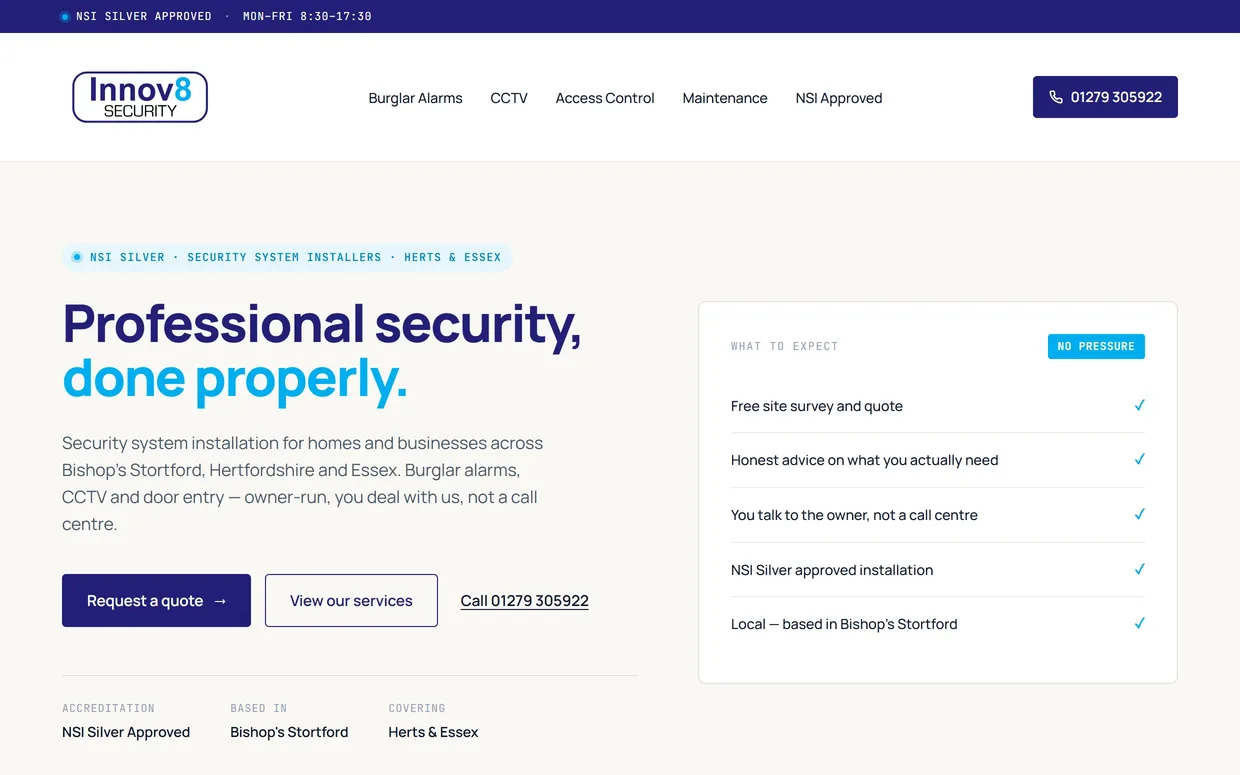
Static files served from Cloudflare’s edge. Innov8 Security scores 100 out of 100 on Google PageSpeed, mobile and desktop, after moving off WordPress.
No database, no admin login, no plugin with a known vulnerability sitting there waiting. There’s very little to attack because there’s very little there.
Nothing auto-updates itself into a broken layout. A site built this way in 2023 still works exactly as it did the day it launched.
Speed and clean structure are two things Google measures directly. It doesn’t win a competitive patch on its own, but it stops you starting from behind.
On Shopify: the theme and the apps are the risk
Shopify does have themes and apps, so the argument above doesn’t transfer — it changes shape. An out-of-date theme is a security risk in its own right and needs bringing current. Apps get installed and never removed: each one injects scripts into your storefront, overlapping apps fight each other, and uninstalled ones leave orphaned code behind in the theme that carries on firing.
The part most store owners don’t see coming is what it costs on the advertising side. A compromised app can put malware into your storefront, and a store flagged for malicious or unwanted software doesn’t just lose customers — it gets its Google Ads suspended and its Merchant Center account with it. Months of Shopping revenue, gone over an app somebody installed once and forgot about.
So a Shopify engagement starts with the theme version and a line-by-line review of every installed app: what it’s actually used for, what it injects, and whether it’s needed at all. Anything not earning its place gets removed or replaced with something that is.
Sites I’ve built and shipped.
Click any of them to see the full page.
I’ve lost more hours to WordPress than you have.
You’re handed the parts of an aeroplane and told it’s easy.
When I started out I was doing what you might be doing now: losing an afternoon to moving a logo three pixels. Hundreds of hours on things that should take minutes. “No code, build it yourself” is the pitch, and it’s true just enough to pull you in.
Then you find out what you actually signed up for. You’re not an avionics engineer, or a structural engineer, or a sheet metal worker — and until the thing fell out of the sky you didn’t know those jobs existed. That’s a plugin stack. Nobody tells you until you’re already in it.
My own site got taken over. I do this for a living.
profitablesites.com ran on WordPress once. I was busy with client work, I wasn’t paying £100 a month for someone to babysit plugins, and one morning my site was a Chinese shop. A marketing consultant’s own website, hijacked, because keeping that stack standing is a part-time job I never wanted.
That’s the day I stopped building on it. If it can happen to me, it can happen to you — and it has probably already happened to someone you know.
At the worst end, it takes the company with it.
A business owner in Kent sold online — on a blogging platform with a shop bolted onto the side. It started with a £500 build from a freelancer: wrong platform from day one, and nobody told him. Then years of offshore developers billing change after change. Over £100,000 in, the site was still bad. “Polishing a turd”, in his words.
Then an SEO firm that was UK in nothing but its address promised him the world at prices that don’t exist, and he stopped the advertising that was actually working in order to pay for it. Six months later the company was gone.
It wasn’t one bad decision. It was a chain of cheap providers, and not one of them ever told him the truth.
Which is why I’d rather tell you something you don’t want to hear in week one than take your money for two years.
Everything a small site needs. Nothing it doesn’t.
Written line by line. No theme, no page builder, no plugin stack. Nothing to update, nothing to break, nothing for a bot to walk through.
Most of your traffic is on 4G with one thumb. Pages are built to load in under a second and hold their layout while they do it.
GA4, form submissions tracked server side so ad blockers don’t eat them, call clicks logged. Nine out of ten accounts I audit have broken tracking. Yours won’t.
Page structure, schema, internal linking and Google Business Profile alignment from the first commit — not sold back to you later as an upgrade.
Copy drafted around what your customer actually needs to know before they call. Click-to-call sized for thumbs, trust signals above the fold.
Files, domain, content, all yours once it’s paid for. Nothing is held back, and nothing stops working if you ever move on.
Quoted per project, fixed before I start.
A landing page, a brochure site and a full store are three different jobs. What moves the number is how many pages there are, how much of the content still needs writing, and whether anything custom has to be built.
You get a fixed quote after the call — I’m not going to price a build I haven’t looked at. Hosting and business email are included on sites I host.
You’re dealing with me. That’s the whole thing.
I’m David Friend. I work out of Braintree, Essex, on my own. The person who quotes you is the person who designs the site, writes the code, wires up the tracking and answers the email six months later when you want the prices changed. There’s no account manager in the middle and no junior doing the actual work.
I design and manage every build directly. The static sites and the tracking setups I write myself; complex bespoke Shopify development goes to my developer, someone I’ve worked with for years, and I project-manage it line by line. Nothing is handed off and nothing arrives that I haven’t checked.
I came up through SEO — the UK’s largest SEO firm, then in-house, then head of SEO at an agency running over a hundred clients — before starting Profitable Sites in 2013 and moving to paid search first by choice. Along the way I took a UK jewellery brand to £35M in revenue across UK and US sites, ranking #1 in both markets for moissanite engagement ring terms.
Which is a long way of saying: a five-page site for a kitchen fitter in Chelmsford gets built by someone who has done the hard version. I work fast because I’m experienced, and I charge accordingly because it works. No agency bloat, no waiting around. You’re getting the person, not a process.
Four steps. Two to three weeks.
A short back-and-forth about the business, the pages, and what the site has to do. Some people want to talk it through first. Some just want to crack on.
I agree the pages and the number with you before I start. Nothing moves after that without you knowing about it, and there is no second invoice at the end.
I build the site on a preview link you can watch fill up. You review it, I adjust it, then I wire in analytics and conversion tracking.
DNS switched, redirects mapped if you’re migrating, Search Console submitted, tracking checked live. The site is yours from that day.
The things people actually ask.
How much does a website cost?
Do I own the website?
What's included in hosting?
Why static HTML instead of WordPress?
How long does a build take?
How many pages do I get?
Can you edit the site for me afterwards?
Can I edit it myself?
Will the site rank on Google?
Do I get analytics and conversion tracking?
What if I already have a website?
Do you build Shopify stores?
Who actually builds it?
Where do you work?
Tell me about the build.
Fifteen minutes and you’ll know what the site should do, what it’ll cost, and how long it takes. If a rebuild isn’t what you need, I’ll tell you that too.
This reaches me directly — one working day, and a real reply written by hand.
Over 100 five-star reviews — 97 verified on PeoplePerHour, plus Google, Clutch and LinkedIn · Google Partner since 2013